
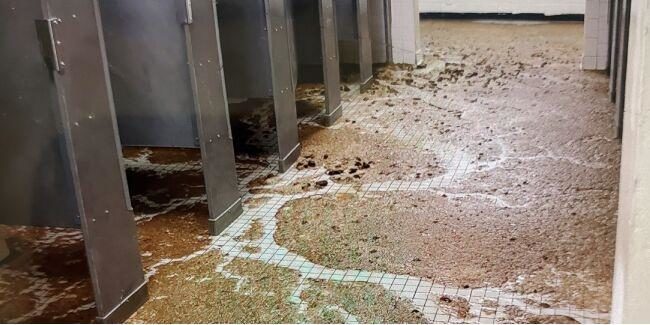
() Sewage backups and inoperable fire systems are among the safety hazards that U.S. service members living in barracks face, according to a new report on how such conditions undermine quality of life and military readiness.
A U.S. Government Accountability Office report found that the Pentagon’s assessments of conditions at barracks “are unreliable” and “observed barracks that pose potentially serious health and safety risks—such as broken windows and inoperable fire systems—and that do not meet minimum [U.S. Department of Defense] standards for privacy and configuration.”
“Thousands of service members live in barracks below standards,” according to the report, which was published Tuesday.
Problems with barracks, where military members live during initial training, have existed for decades. The Department of Defense has not fully funded its facilities program for years leading to a backlog of at least $137 billion in deferred maintenance costs as of fiscal year 2020, according to the report.
Sen. Roger Wicker, R-Miss., ranking member of the Senate Armed Services Committee, called the report troubling.
“This report’s findings are shameful and troubling for the future of our force,” Wicker said.
“Our servicemembers deserve a safe place to live and work,” he continued. “Failing to provide this basic necessity harms readiness and discourages recruitment and retention.”
Wicker said he hoped the defense appropriations bill currently under negotiation would include provisions for “increased oversight” and establish a set of “basic habitability standards” that the military must comply with, along with “targeted funding” to address those specific shortfalls.
“Rest assured that we are committed to ensuring these changes are implemented through conference,” he said.
U.S. military services generally require enlisted service members in certain ranks without dependents to live in barracks.
One problem is that barracks often fall low on the priority list. But that’s not the only issue.
“The military services assess barracks conditions by developing condition scores for each barracks facility, but condition scores have been unreliable with respect to barracks conditions,” according to the report. “Further, some barracks pose serious health and safety risks and do not meet DOD standards for privacy and configuration, such as size, number of bedrooms, and kitchen requirements.”
Military services calculate a condition score, which is a number from 0 to 100, for the facilities. But those scores didn’t always match conditions in the barracks.
“We observed barracks at seven of 10 military installations we visited that appeared to require significant improvement, despite condition scores above 80,” according to the Government Accountability Office report.
“The scores indicated that barracks were in fair or good condition. For example, at one installation, we toured a barracks facility that had been closed for renovation due to long-standing plumbing and electrical issues,” the report said. “According to installation officials, the barracks was uninhabitable. However, at the time the barracks closed, its condition score was above 90, according to service documentation.”
Those living in the barracks said they were sometimes “unacceptable” and “continuous misery,” according to the report.
At one site, the Government Accountability Office report said “former residents of this barracks told us they experienced months of hot water interruptions and routinely dealt with clogged showers, broken door locks, broken elevators, and apparent mold growth. Senior-enlisted service members—such as first sergeants or those in similar positions—who supervised the junior service members living in these barracks told us living conditions were unacceptable.”
At another facility, with a score of 86, a quarter of the air conditioning units didn’t work.
“Service members we met with at this installation described living in the barracks without air conditioning on hot days, especially after being outside all day for work or training, as continuous misery,” according to the report.
The report found the problems were widespread and, in some cases, dangerous.
“We found that living conditions in some military barracks may pose potentially serious risks to the physical and mental health of service members, as well as their safety,” according to the report. “During site visits, we observed a variety of living conditions that service members and unit leaders told us were negatively affecting them, such as the presence of mold, broken fire alarm systems, and extreme temperatures, among others.”
The problems listed in the 118-page report from the Government Accountability Office were numerous.
“First sergeants at one installation told us an ex-spouse broke in and physically assaulted a service member in the barracks and that poorly lit hallways, blind spots in hallways and corridors, and lack of security cameras made barracks difficult to monitor,” according to the report.
The Government Accountability Office report made 31 recommendations to Pentagon to improve conditions at barracks.
“Poor living conditions in these facilities affect service members’ quality of life and undermine readiness and mission,” according to the report’s conclusion. “Improving barracks conditions and addressing the quality-of-life and morale issues associated with poor conditions has multiple facets—including funding, oversight, and collaboration—and addressing these issues will require DOD to take actions in multiple areas.”
Deputy Assistant Secretary of Defense for Housing Patricia Coury said in a response to the report that “Corrective Action Plans for each recommendation will be developed by my office with input from the Military Departments.”