
(Mike Maharrey, Money Metals News Service) When I was about 7 years old, my friend Tommy and I decided we were going to dig a cave. We envisioned a massive cavern we could stand up in. It would be our secret fort. We went as far as digging a pretty deep hole in Tommy’s backyard.
It was a dumb idea.
But our cave-building scheme wasn’t nearly as dumb as the notion that simply minting a trillion-dollar coin can solve America’s debt problem.
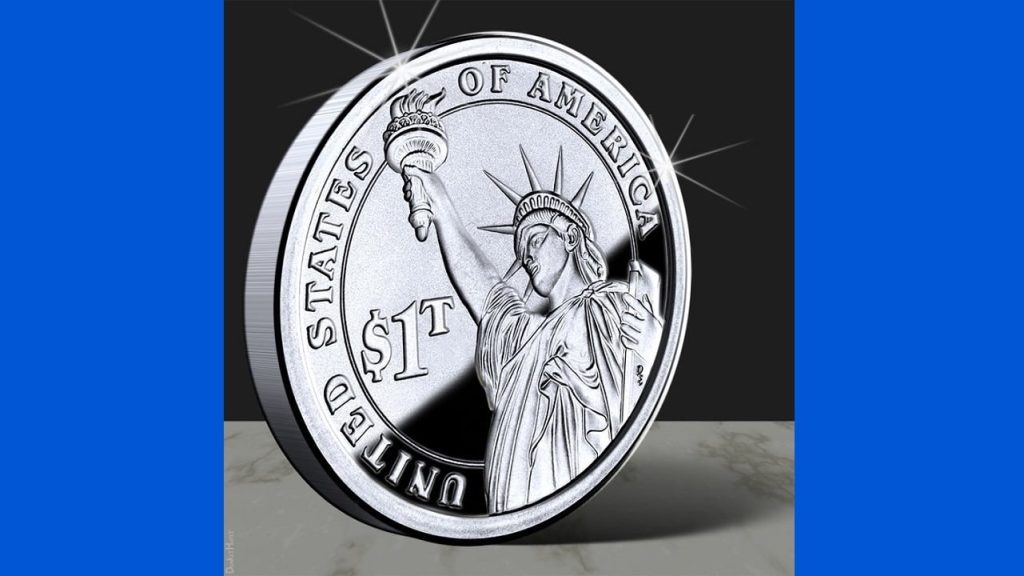
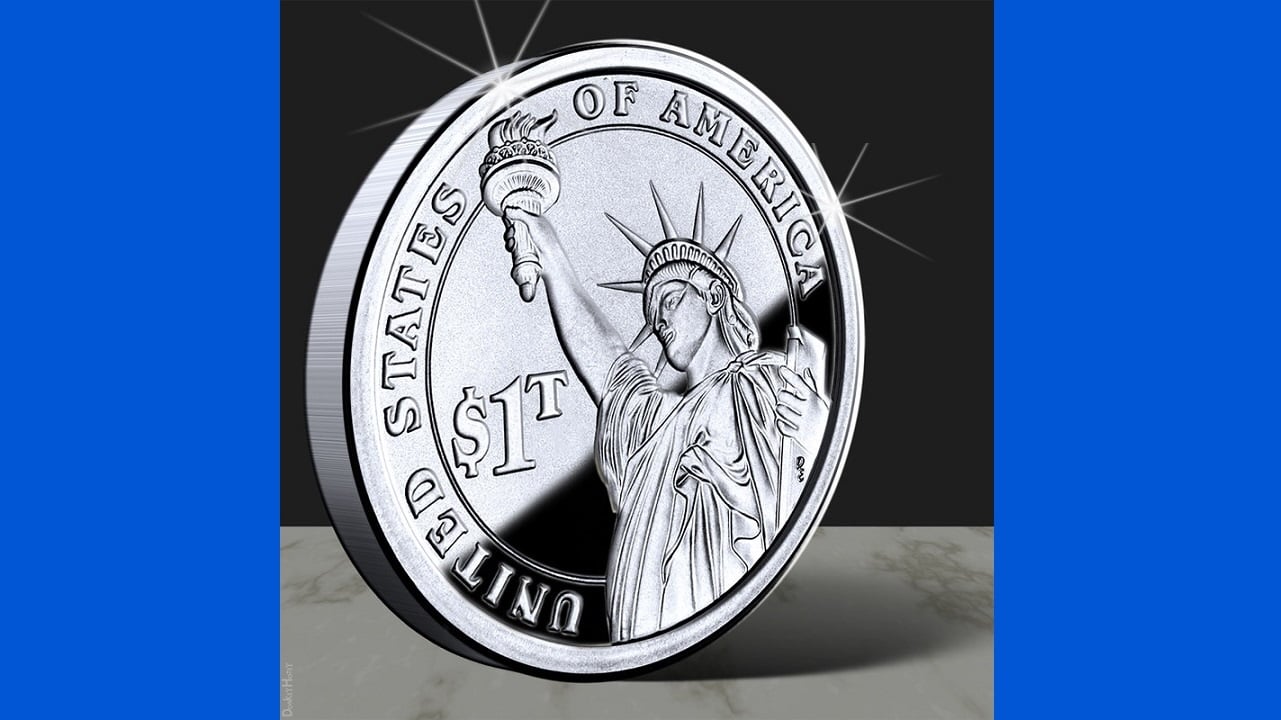
The idea is pretty simple. The U.S. Treasury could mint a $1 trillion platinum coin, deposit it at the Federal Reserve, and then the federal government could write checks against that asset.
Voila! Budget problem solved.
Now, it may sound a little bit like creating money out of thin air.
That’s because it is. But hey, if it’s legal, why not?
I’ll be honest; when people were discussing the trillion-dollar coin during the 2023 debt ceiling fight, I thought it was just an attention-grabbing political gimmick. Even Janet Yellen eventually nixed the idea. Surely nobody seriously considered such a scheme, right?
Wrong.
Documents obtained by Bloomberg investigative journalist Jason Leopold reveal that government officials discussed the feasibility of minting a trillion-dollar coin on at least two occasions in 2013 and 2015.
According to a heavily redacted November 2013 memo, Treasury Department officials and Department of Justice lawyers discussed the legality of issuing a “large denomination coin in order to obtain funds for making debt payments and other expenditures if Congress fails to raise the debt ceiling.”
A second memo dated Oct. 27, 2015, reveals another round of discussions about the legality of such a scheme.
It seems to me they should probably consider the economic ramifications before fretting over legal minutia, but that’s just me.
Yale professor Jack Balkin promoted the $1 trillion coin scheme back in 2011. Here’s how it would work:
“Sovereign governments such as the United States can print new money. However, there’s a statutory limit to the amount of paper currency that can be in circulation at any one time.
“Ironically, there’s no similar limit on the amount of coinage. A little-known statute gives the secretary of the Treasury the authority to issue platinum coins in any denomination. So some commentators have suggested that the Treasury create two $1 trillion coins, deposit them in its account in the Federal Reserve and write checks on the proceeds…
“The ‘jumbo coin’ [strategy works] because modern central banks don’t have to print bills or float debt to create new money; they just add money to their customers’ checking accounts.”
In effect, it would be no different than the quantitative easing operations (QE) the Federal Reserve currently runs to expand the money supply.
In a QE operation, the Federal Reserve buys securities (primarily U.S. Treasuries and mortgage-backed securities). The catch is the money to buy these assets doesn’t exist until the Fed “writes a check” for the purchase. Imagine your bank honoring a check you wrote even though your balance was zero. That’s QE in a nutshell. The central bank creates the money out of thin air and injects it into the economy.
The trillion-dollar coin scheme would have the same practical effect as QE, but the government would be off the hook from having to pay off bonds on the Fed balance sheet. Instead of having to borrow money by issuing bonds for the Fed to later monetize, the government would just create the money itself bypassing the Fed middleman.
So, what’s the problem?
Well, we just saw what happens when the Fed creates money out of thin air. During the pandemic, the central bank created nearly $5 trillion through quantitative easing. After that, prices went through the roof. This was inevitable because money creation is, by definition, inflation. One of the consequences of monetary inflation is price inflation.
Minting a trillion-dollar coin would have a similar effect.
The coin is just a prop for monetary kabuki theatre to make it all seem legal and above board. They wouldn’t even use 1 trillion dollars in platinum. If they did, it would weigh over 60 million pounds.
In fact, they don’t even need the coin. As economist Robert Murphy explained, the Treasury could sell a paperclip to the central bank. Just imagine a QE operation using a paperclip instead of Treasury bonds.
“The Federal Reserve has the power to buy whatever assets it wants at whatever price it wants. In principle, [the Treasury Secretary] could sell a paperclip to the Fed for $2 trillion. The Fed would simply write a check made out to the Treasury, drawn on the Fed itself.
“When the Treasury deposited this check with its own bank — which just so happens to be the Fed — then its own ‘checking account’ balance would go up by $2 trillion. This money wouldn’t come from anywhere in the sense that some other account would need to be debited $2 trillion. On the contrary, the system’s total reserves (and what is called the ‘monetary base’) would have swelled by $2 trillion. The Treasury would be free to start paying bills by writing checks on the $2 trillion in its account.”
Nevertheless, some people think this is a great idea. In their minds, it would be “free money.”
But as the saying goes, there ain’t no such thing as a free lunch. You would pay for the $1 trillion coin through the inflation tax – just like you’re still paying for the pandemic-era stimulus every time you go to the grocery.
Minting a coin or selling a paper clip and pretending it is worth $1 trillion doesn’t change the economic dynamics. When you boil it all down, it’s just a weird scheme to increase the money supply.
And I can’t emphasize this enough – increasing the money supply is inflation.
In theory, the government could keep price inflation under control by using the newly created funds judiciously and with restraint. In theory, they could just dribble the new money out slowly as they need it to minimize the inflationary effect. In theory, it could work!
And in theory, Tommy and I could have dug a cave fort.
Let’s be honest – judicious and restrained aren’t qualities you find in politicians. They’d blow through that $1 trillion like a spring tornado through Kansas. And when they spent it all, they’d mint another coin. And another. And another.
There would be no dribble. It would unleash a cascade of spending on top of the tidal wave we already have.
But this is what you get when you have an entire school of economics that disconnects money from stuff.
Sure, the federal government could mint a $1 trillion coin. But it can’t mint stuff. It can’t create stuff out of thin air. It can’t mint cars, food, clothing, houses, and cell phones. It can’t wave a wand a create vital services.
But don’t you worry! We’re dealing with “smart” people here. They’ll tell you, “Don’t worry! This is different.” And then they’ll start spinning. They’ll offer up seemingly plausible reasons a $1 trillion coin will work. They’ll couch it in academic speak and technical jargon to make it sound even more plausible. They’ll yammer about how the dollar is the global reserve currency and everybody wants more of them. They show you some convincing-looking accounting tautologies. They’ll babble and gesticulate. And suddenly, you’ll be thinking, “Heck yeah! Mint that $1 trillion coin! That’s the ticket!”
No.
It’s dumb.
Tommy and I quickly realized our cave fort was a dumb idea. But unfortunately, dumb ideas spun out in the hallowed halls of government rarely die so easily.
Photo by Donkey Hotey used under Creative Commons license.
Mike Maharrey is a journalist and market analyst for MoneyMetals.com with over a decade of experience in precious metals. He holds a BS in accounting from the University of Kentucky and a BA in journalism from the University of South Florida.