
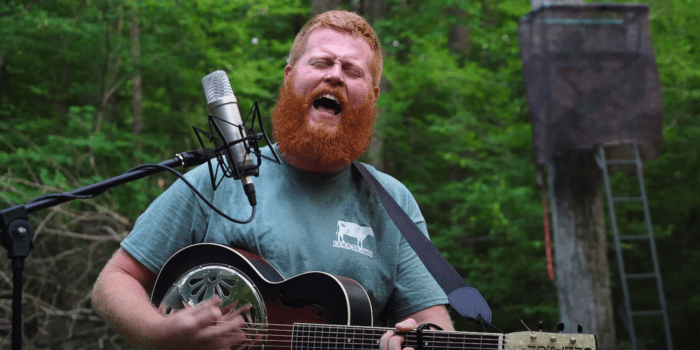
(Ben Sellers, Headline USA) If former President Donald Trump and his 18 Fulton County co-defendants need compelling proof that the 2020 election was stolen, they need look no farther than the stunning overnight success of Oliver Anthony’s “Rich Men North of Richmond.”
Unlike voting machines, the music charts don’t lie, and Anthony’s inspiring journey to the top of the Billboard Hot 100 is a testament not only to the silent majority’s ongoing cultural relevance, but its dominance.
The Top 10 of this week’s Billboard Hot 100. pic.twitter.com/IQ1cbWI1gz
— Pop Base (@PopBase) August 21, 2023
Adding to the marvel of the moment was that two other country songs rounded out the top three on the all-genre chart.
Collectively (along with Jason Aldean’s recent hit “Try That in a Small Town”), they each cast light on a different facet of the divide between red-state, working-class values and the virtue-signaling, mass-produced consumerism put forward by smug, out-of-touch Hollywood elites.
Even far-left sites have begun taking note of the industry trend, and their simmering resentment is palpable.
“Despite lyrics that reference QAnon themes and mock people on welfare with what many have read as racist stereotypes, the song is so popular that Anthony now has 18 songs currently ranking in the Apple Music Top 100,” seethed Vox writer Aja Romano.
Ironically, country music sell-out Taylor Swift held Billboard’s fourth spot, just below Morgan Wallen, whom leftists tried to cancel a few years ago following his use of the n-word in a candid video posted online.
But it is the unique dynamics of the top-two songs as cultural touchstones of an especially volatile and precarious moment in American history that bear digging into further.
A STAR IS BORN
For two full weeks, I have struggled with how to cover Oliver Anthony (real name: Christopher Lunsford), the Farmville, Va., resident whose stripped-down folk ballad— reminiscent of Old Crow Medicine Show, yet burning with Woody Guthrie-like populist rage and intensity—struck a nerve in the national Zeitgeist.
The song sprung from the bowels of the Internet at a particularly busy time in the news cycle, with Trump’s indictments and unfolding developments in the Biden bribery scandal generating more daily leads than a mid-size news site could keep up with.
But more than that, nothing about Anthony’s music, at first, seemed especially remarkable to me, having spent a number of years as a music editor in Charlottesville (an hour west of Richmond) and Fredericksburg (an hour north of Richmond, halfway to D.C.).
While I had known a few rich men in those cities, I had also known quite a few starving-artist types, and Anthony’s back-woodsy sound was all too familiar.
His lyrics were poignant, to be sure, but seeing conservatives rally behind a symbolic cause—be it the embrace of the “Lets Go Brandon” mantra, the Bud Light boycott or the box-office success of Sound of Freedom—has become something of a pattern, in and of itself.
Thus, the cultlike popularity of the ditty in certain circles was hardly enough to justify anything more than a passing acknowledgment or a Twitter repost.
However, Anthony’s star continued to rise. Following reports of a massive reception at a show in North Carolina last week, I reached out for an interview, but by then the bandwagon had already left the station.
LIGHTNING IN A BOTTLE
As was acknowledged at the Republican debate Wednesday, Oliver Anthony’s anthem has, indeed, become a cultural phenomenon.
WATCH: The first question of the #GOPDebate is about Oliver Anthony’s ‘Rich Men North of Richmond’
“Why is this song striking such a nerve in this country right now? What do you think it means?” pic.twitter.com/NNjnFAlkZH
— Breaking911 (@Breaking911) August 24, 2023
I have no better answer than the candidates as to what it is that the 31-year-old Anthony tapped into, specifically, but I can no longer live in denial that the song is here to stay—and the tingle it delivers to one’s spine is very real.
The question, then, is what can we expect of the man behind the movement?
Anthony—who reportedly turned down an $8 million recording contract and continues to perform free shows, according to his Facebook page—seems to believe that the power of his music and message will carry over into his artistry more broadly.
Having listened to a selection of his other songs, which bear a similar style but don’t quite resonate on the same frequency, I’m not convinced that he will have staying power in an industry that is rooting to see him fail, particularly with the pressure he now faces in trying to recapture lightning in a bottle and replicate his successful formula with something new and meaningful.
Nonetheless, with his new song, “Brink of War,” having recently dropped, I welcome the chance to be proven wrong yet again.
BREAKING: Oliver Anthony releases new ‘Brink of War’ song pic.twitter.com/bPvV6xxyOk
— Jack Poso 🇺🇸 (@JackPosobiec) August 23, 2023
Then again, perhaps the true authenticity of Anthony’s message, rather than trying to continue building on his newfound fame, will be to ride the current wave of success as far as it takes him and be content with letting his career-defining hit stand as his first and only contribution to the historical record.
THE UNIVERSAL STRUGGLE
Equally fascinating to me has been the revitalization—and recontextualization—of another one-hit wonder, Tracy Chapman, in Luke Combs’s current No. 2 hit, “Fast Car.”
On one hand, the song does what far too many of Music Row’s offerings these days do, digging through the back catalog of old, forgotten hits to recycle into “safe” chart-toppers in lieu of paying songwriters to create new music that could miss its mark.
But the intriguing quality about Combs’s selection was that Chapman would seem, at first, to be the polar opposite of himself and his audience.
The black, lesbian singer–songwriter earned her living busking outside Harvard Square before releasing her 1988 debut, with its hit single. She had a second hit, 1995’s “Give Me One Reason,” before fading into quiet obscurity.
But 35 years later, Combs is connecting Chapman’s experience as a struggling black woman with the more common shared experiences of forgotten, blue-collar country music fans—and, remarkably, nothing seems to have been lost in translation.
Chapman, now 59, seems awed by the newfound success in an unlikely genre. “I never expected to find myself on the country charts, but I’m honored to be there,” she told Billboard as the song continued its chart dominance. “I’m happy for Luke and his success and grateful that new fans have found and embraced ‘Fast Car.’”
The song’s success speaks to the power of great songwriting and to the universality of the struggles it conveyed in its thoughtful lyrics—something that does not fit with the Left’s narrative of systemic racism and white privilege.
Like Chapman’s song, is clear that Oliver Anthony’s is already bridging racial and cultural gaps, as well as generational ones.
This song hits home for all of us. pic.twitter.com/6dJAJD0jWW
— charmane harbert ️ 🇺🇸 (@callme_Chari) August 17, 2023
For his part, Anthony has been pointedly apolitical, noting that he condemns equally the “rich men” in both parties.
With that in mind, he might not be too keen to testify before the Fulton County jury, since he seeks an audience that transcends political labels.
But even if his success can’t tell us about the 2020 election, it can offer clues as to what lies ahead in 2024 and beyond: a growing wave of populist backlash that could spread just as quickly, forcefully and unexpectedly as “Rich Men North of Richmond” has, for those who aren’t paying close enough attention to see the signals.
Ben Sellers is the editor of Headline USA. Follow him at twitter.com/realbensellers.