
(Tom Gantert, The Center Square) The U.S. Supreme Court ruled Friday by a 6-3 vote that banning homeless encampments on public property does not constitute “cruel and unusual” punishment.
The city of Grants Pass, Oregon v. Gloria Johnson was called “the most significant case about homelessness in 40+ years” by The National Homeless Law Center.
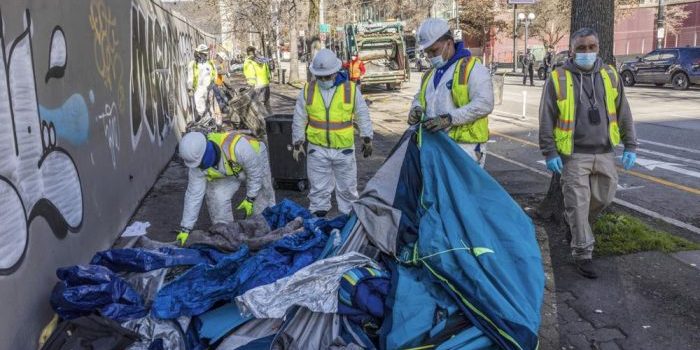
Grants Pass has public-camping laws that restrict homeless encampments on public property. Cities across the country, especially in California, have enacted similar laws to restrict homeless encampments on public property.
The nation’s highest court addressed the question: “Does the enforcement of generally applicable laws regulating camping on public property constitute ‘cruel and unusual punishment’ prohibited by the Eighth Amendment?”
The Ninth Circuit Court ruled that the Eighth Amendment’s Cruel and Unusual Punishments Clause prohibited cities from enforcing public-camping ordinances against homeless people if there were no “practically available” shelter beds. The U.S. Supreme Court reversed that decision.
Justice Neil Gorsuch wrote, “The Court cannot say that the punishments Grants Pass imposes here qualify as cruel and unusual. The city imposes only limited fines for first-time offenders, an order temporarily barring an individual from camping in a public park for repeat offenders, and a maximum sentence of 30 days in jail for those who later violate an order.”
Gorsuch continued: “Such punishments do not qualify as cruel because they are not designed to cause ” “terror, pain, or disgrace. … Nor are they unusual, because similarly limited fines and jail terms have been and remain among “the usual mode[s]” for punishing criminal offenses throughout the country.”
Justice Sonia Sotomayor wrote in the dissenting opinion: “Sleep is a biological necessity, not a crime. For some people, sleeping outside is their only option. The City of Grants Pass jails and fines those people for sleeping anywhere in public at any time, including in their cars, if they use as little as a blanket to keep warm or a rolled-up shirt as a pillow. For people with no access to shelter, that punishes them for being homeless. That is unconscionable and unconstitutional. Punishing people for their status is ‘cruel and unusual’ under the Eighth Amendment.”
But Justice Gorsuch disagreed.
“Grants Pass’s public-camping ordinances do not criminalize status,” Gorsuch wrote. “The public-camping laws prohibit actions undertaken by any person, regardless of status. It makes no difference whether the charged defendant is currently a person experiencing homelessness, a backpacker on vacation, or a student who abandons his dorm room to camp out in protest on the lawn of a municipal building.”
Advocates to end homelessness criticized the decision.
“This decision sets a dangerous precedent that will cause undue harm to people experiencing homelessness and give free reign to local officials who prefer pointless and expensive arrests and imprisonment, rather than real solutions,” said Ann Oliva, CEO of the National Alliance to End Homelessness, in a statement. “At a time when elected officials need to be focused on long-term, sustainable solutions that are grounded in evidence – including funding the affordable housing and supportive services that their constituents need — this ruling allows leaders to shift the burden to law enforcement. This tactic has consistently failed to reduce homelessness in the past, and it will assuredly fail to reduce homelessness in the future.”
California Senate Minority Leader Brian Jones, a Republican from San Diego, applauded the ruling.
“Today’s decision rightly empowers state and local officials to compassionately clear encampments. Californians should not have to tolerate the encampments that have taken over our communities,” Jones said in a statement. “This is not about criminalizing homelessness — it’s about ensuring the safety of both the community and homeless individuals. With this decision, Democrat politicians can no longer justify allowing this severe public health and safety crisis to persist on our streets. It’s time to clean up California.”