
(Ken Silva, Headline USA) Talk about irony: The FBI, which was willing to use deadly force over Donald Trump allegedly mishandling classified documents, has been systematically mishandling similar information for years, according to bombshell findings released Thursday by Justice Department Inspector General Michael Horowitz.
The DOJ-IG said it discovered the FBI’s mishandling of classified information while auditing a contract related to how the bureau destroys electronics containing “sensitive-but-unclassified” information, as well as classified national security information.
According to Horowitz’s audit, the FBI labels computers that handle such information when it sends them to a facility to be destroyed. However, it does not label internal hard drives extracted from those computers. The FBI also doesn’t properly track thumb drives and disk drives containing information of varying classification levels, according to Horowitz.
Compounding the security risk is the fact that those unmarked internal hard drives, thumb drives and disk drives often end up in a physically unsecured warehouse.
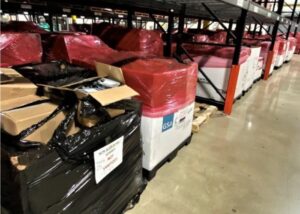
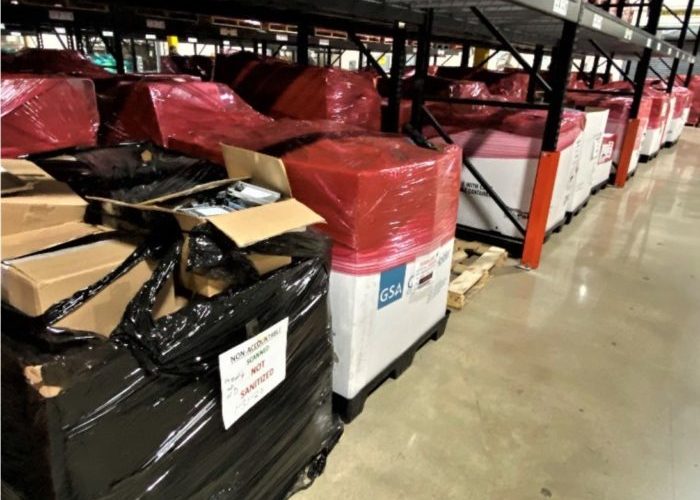
Horowitz said that when his staff visited an FBI “Media Destruction Team” facility last October, they found “non-accountable” hard drives and other electronic storage devices sitting in an open pallet-sized box. Horowitz said he’s not disclosing details about the facility since it’s not secured.
“A [property-turn-in] staff member told us that the pallet for the loose media was unsecured for extended periods, sometimes spanning days or even weeks because PTI would wrap the pallets and move them to the Facility shelves only when the box reached full capacity,” the Inspector General said.
During the same visit last October, Horowitz said his staff also found a container from January 2022 that identified its contents as “non-accountable.”
“Notably, the container’s shrink wrapping was torn, and boxes inside were visibly open and contained hard drives marked Secret,” he said.
BREAKING: The DOJ-IG has found that the FBI systematically mishandled TROVES of classified information.
Pictured below is an FBI storage facility. The camera above the door doesn’t work, and the doors were kept open at all hours — allowing non-authorized personnel access to… pic.twitter.com/QRbvU8FPcy— Ken Silva (@JD_Cashless) August 22, 2024
Horowitz added that after his team spotted the box, the FBI’s Asset Management Unit “promptly secured” it with additional shrink wrap. However, the FBI’s PTI supervisor and contractor told Horowitz that they would not be aware if someone was to take hard drives from the pallets because these assets are not counted or otherwise tracked.
According to the DOJ-IG, at least 395 people have access to the FBI’s unsecured facility as of May, including 28 task force officers and 63 contractors from at least 17 companies.
“There is no physical barrier preventing FBI and non-FBI personnel and contractors from other Facility operations from accessing PTI’s work area and the pallets of unsanitized assets in the Facility shelving space,” he said.
And even though there is apparently a door to the Media Destruction Team’s work area, the FBI doesn’t close it to prevent non-Asset Management Unit personnel from accessing the area, the IG found.
If all those security failures weren’t enough, Horowitz also said one of the key surveillance cameras at the facility wasn’t working when his team visited. The FBI apparently told Horowitz last December that it was installing a new camera there, but it still wasn’t in place when the DOJ-IG made a follow-up visit in February.
“We believe that the combination of the FBI’s lack of accountability of the electronic storage media, lack of internal physical access control, and lack of sufficient video surveillance compounds the risk of media, potentially with sensitive and classified information, being lost or stolen without detection,” Horowitz concluded.
It appears as if the problems identified by Horowitz have been around for almost a decade, if not longer.
During his investigation, Horowitz said his staff determined that an interim accreditation was granted in 2015, but had expired in March 2016. An accredited open-storage secure area is a space with reinforced construction in which classified materials, up to and including at the Secret collateral level, may be stored.
“Following our observations, the FBI performed a site visit in November 2023 to confirm the remediation of the security enhancements required from a 2015 open storage inspection checklist. The FBI granted the Facility its final open storage accreditation in January 2024,” he said.
“The FBI stated that the lack of final accreditation was an administrative oversight and that enhancements had been completed in the interim. However, the FBI could not provide evidence of when the required enhancements were completed.”
FBI whistleblower Greg Roman told Headline USA that the label “Classified National Security Information” indicates some of the FBI’s unsecured boxes potentially contained Top Secret information.
“Second, it appears the location of this facility warehousing these hard drives, flash drives, floppy disks ie external media is located in Cheverly, MD just outside of Washington DC: Does that mean FBI offices from across the country were sending this ‘stuff’ to an undisclosed FBI facility near DC for proper destruction?” Roman added.
“That might indicate why none of was marked.”
The IG said his audit is still ongoing, but he wanted to alert the FBI about its problems so they can fix them promptly. The IG made a series of recommendations for how the FBI could improve its security and disposal procedures, and the bureau agreed with them all—such as placing its boxes of non-accountable hard drives inside secure cages at the warehouse.
Ken Silva is a staff writer at Headline USA. Follow him at twitter.com/jd_cashless.