(Headline USA) With little else to run on, Biden Democrats have resorted to the lowest and most desperate tactics imaginable in a last-ditch bid to pad their numbers.
While President Joe Biden’s top talking point may be fearmongering about the existential threat that democracy faces if he is not re-elected, the Left’s backup plan is to use wedge issues that play to their favor, such as abortion and drug legalization as bait for otherwise disaffected voters.
Thus, activists have undertaken a mad dash to artificially foist the issues into public debate, even when nobody is clamoring for them.
In Florida, a mass exodus from blue states like New York during the coronavirus lockdowns led many to regard it as a sort of conservative utopia—the Right’s answer to California.
The Sunshine State has turned increasingly red since the 2018 election of GOP Gov. Ron DeSantis, even prompting a relocation by then-President Donald Trump, as well as many of his GOP supporters
A decision by Democrats to cancel their primary election in order to protect Biden resulted in even more gains for the red team as several municipal elections drew stronger Republican turnouts.
However, Democrats are hoping for a drastic reversal that could shift the state back into “battleground” territory if all goes according to plan in the November general election.
The Florida Supreme Court issued rulings Monday allowing the state’s voters to decide whether to protect abortion and legalize recreational use of marijuana, rejecting the state attorney general’s arguments that the measures should be kept off the November ballot.
The court was not ruling on the merits of the measures, but only whether they meet the requirements for clarity and don’t violate the state constitution’s mandate that they only cover one subject.
The court’s ruling came the same day it upheld the state’s ban on most abortions after 15 weeks of pregnancy.
State lawmakers had tightened the ban to six weeks while the issue was still in court. Monday’s ruling, therefore, likely paves the way for the six-week ban to go into effect.
ABORTION
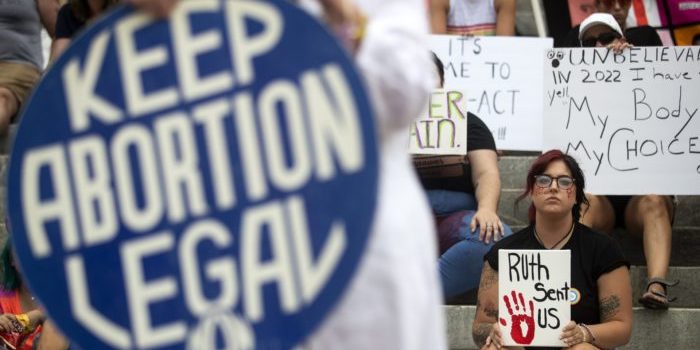
The justices by a 4-3 vote approved for the ballot a proposed amendment that would protect abortion, even though the law is not under threat in Florida. The four male justices constituted the majority, while the three women opposed allowing the measure to proceed.
The proposed amendment says “no law shall prohibit, penalize, delay, or restrict abortion before viability or when necessary to protect the patient’s health, as determined by the patient’s healthcare provider.” It provides for one exception that is already in the state constitution: Parents must be notified before their minor children can get an abortion.
The majority rejected Republican Attorney General Ashley Moody’s argument that the proposed amendment is deceptive and that voters won’t realize just how far it will expand access to the procedure.
They also rejected an argument that the measure violates the single-subject clause because it would both allow abortions before the fetus is viable and for the mother’s health.
The opponents had argued that some voters might approve of allowing abortions to protect the mother’s health, but would reject allowing unrestricted abortions before viability. They claimed those were separate subjects.
Under both Florida and federal law, “abortion has historically involved two major interconnected matters: the viability of the fetus and the health of the mother,” the court’s four men insisted.
“The mere fact that electors might not agree with the entirety of the amendment does not render it violative of the single-subject requirement,” the justices wrote.
Writing for the dissenters, Justice Jaime Grosshans argued that the measure’s ballot summary was misleading and should have been rejected.
“The summary does not give the voter any clarity on the decision they must actually make or reveal the amendment’s chief purpose,” she wrote. “Instead, it misleads by omission and fails to convey the breadth of what the amendment actually accomplishes—to enshrine broad, undefined terms in our constitution that will lead to decades of litigation.”
DeSantis’s office issued a statement criticizing the ruling and supporting “the three women on the Court who got it right.” He appointed all three women to the court and two of the four men.
“This amendment is misleading and will confuse voters,” the statement said. “The language hides the amendment’s true purpose of mandating that abortions be permitted up to the time of birth.”
But Anna Hochkammer, executive director of Florida Women’s Freedom Coalition, applauded the decision, calling it “a huge step forward in our ongoing fight to safeguard a woman’s right to have an abortion and to limit government interference in their personal healthcare decisions.”
“The overwhelming response from Floridians from every political affiliation, religion and walk of life signifies that this issue transcends partisan politics; it’s about healthcare, plain and simple,” she claimed.
Florida will now be one of several states where voters could have a direct say on abortion questions this year.
Referendums to guarantee abortion are set for Maryland and New York, and activists on both sides of the issue in at least seven other states are working to get measures on 2024 ballots.
RECREATIONAL MARIJUANA
The justices voted 5-2 to allow on the ballot a measure that would permit companies already growing and selling medical marijuana to sell it to adults over 21 for any reason.
The ballot measure also would make possession of marijuana for personal use legal.
Moody argued that the proposal was deceptive, in part, because federal law still doesn’t allow recreational or medical use of marijuana. She argued that the court previously erred when it approved the language for the medical marijuana ballot initiative voters passed in 2016.
In the majority opinion, Grosshans rejected Moody’s argument, saying the measure would not confuse voters as it “clearly states that the amendment legalizes adult personal possession and use of marijuana as a matter of Florida law.”
Grosshans rejected an argument by others that the measure violated the prohibition against multi-subject ballot measures because it both decriminalized marijuana and allowed for its sale. Grosshans wrote that those two were logically linked.
“Legalization of marijuana presumes the product will be available for the consumer. Likewise, the sale of personal-use marijuana cannot be reasonably undertaken while possession is criminalized. Selling and possessing marijuana appear, for better or worse, directly connected,” Grosshans wrote.
Adapted from reporting by the Associated Press