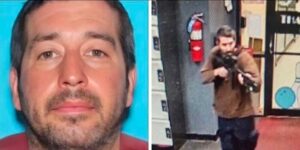
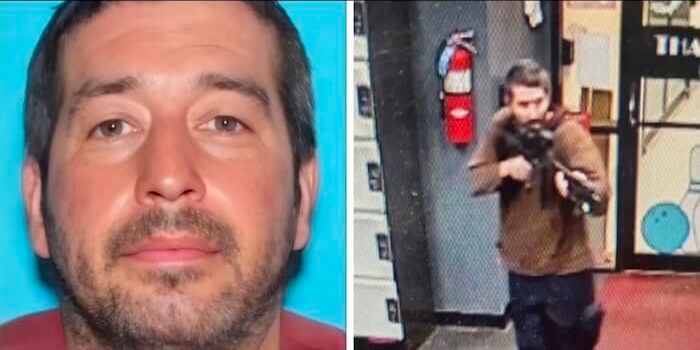
(Ken Silva, Headline USA) The final report on mass shooter Robert Card was released Tuesday by a special commission created to investigate his attacks, which killed 18 people, marking the deadliest shootings in Maine history.
The 215-page document made similar findings as the United States Army Reserve Command. The special commission said both the Army Reserve and police missed opportunities to intervene in a gunman’s psychiatric crisis and initiate steps to seize weapons from the spiraling reservist. The commission also faulted the Army Reserve for failing to do more to ensure Card’s health and deal with his weapons.
However, the special commission report—formed by Maine Gov. Janet Mills—did release new public information about Card’s drug history.
According to the report, Card’s autopsy found no evidence of this or any other medication in his system.
The independent commission report released last week says Maine mass shooter Robert Card didn’t have any meds in his system.
That may have been the problem. He wasn’t taking a prescription to treat schizophrenia, according to the report. pic.twitter.com/VVEWyR2gGn— Ken Silva (@JD_Cashless) August 21, 2024
That might have been the problem. The report detailed how Card’s mental health improved when he was prescribed Olanzapine, a drug for schizophrenia. But then, Card eventually stopped taking the medication within just a few days, the report said.
“After the Lewiston shootings, the Maine State Police obtained a search warrant for Card’s home. They found a prescription for Olanzapine for 60 pills that was filled on August 3, 2023,” the report said.
“The instructions were to take one pill in the morning and one at night. They found 53 pills left in the container. A postmortem examination and autopsy found no evidence of this or any other medication in Card’s system.”
The commission’s report didn’t mention that Card had a bizarre “egg-sized lump on his head from an unknown origin” that one of his colleagues apparently noticed in June 2023.
The commission began its work a month after the mass shootings by Card, who killed his victims at a bowling alley and a bar and then took his own life. Over nine months, there has been emotional testimony from family members and survivors of the shooting, law enforcement officials, U.S. Army Reserve personnel and others.
The commission praised the swift response by police to the shootings but also noted what a former chief justice of Maine’s highest court described Tuesday as “utter chaos” as hundreds of law enforcement officers arrived to search for the gunman. The only recommendation issued by the commission was for state police to conduct an after-action review.
Family members and fellow reservists said Card had exhibited delusional and paranoid behavior months before the shootings. He was hospitalized by the Army during training in July 2023 in New York, where his unit was training West Point cadets, but Army Reserve officials acknowledged that no one made sure Card was taking his medication or complying with his follow-up care at home in Bowdoin, Maine.
The starkest warning came in September text from a fellow reservist: “I believe he’s going to snap and do a mass shooting.”
The commission report contained new details of Card’s time at a private psychiatric hospital — Four Winds in Katonah, New York — where Card acknowledged having a “hit list” and officials planned to ask a judge to extend Card’s hospitalization. But the court hearing never happened, and his psychiatrist felt the hospital’s request would have been unsuccessful, given Card’s stabilization and progress and his agreement to continue medications and participate in therapy. The psychiatrist thought he was safe to discharge after 19 days.
The report also took up New York’s red flag law but didn’t reach a conclusion on whether it should have been used to remove Card’s weapons while he was in New York. An Army health care worker testified he didn’t think he could initiate action to remove guns from someone who was not a New York resident. The report, however, noted that petitions were successfully initiated under New York’s extreme risk protection law against nonresidents, though it was unclear if the law could have been enforced at the time in Maine.
Army officials conducted their own investigation after the shootings that Lt. Gen. Jody Daniels, then the chief of the Army Reserve, said found “a series of failures by unit leadership.” Three Army Reserve leaders were disciplined for dereliction of duty, but details of the disciplinary actions are being kept secret.
The commission report noted that the last call to Card’s cellphone was from the Army Reserve Psychological Health Program the day before the shooting. He hung up when the caller identified herself. That same day, he also received the last of five emails from the Army Reserve Medical Management Center; he didn’t respond to any of them, the report said.
After the shootings, Maine’s Legislature passed new gun laws for the state, which has a tradition of hunting and firearms ownership, after the shootings. A three-day waiting period for gun purchases went into effect this month.
The seven-member commission included two former federal prosecutors; two additional former judges, including a former member Maine’s highest court; the state’s former chief forensic psychologist; and a private psychiatrist who is an executive at a psychiatric hospital.
Ken Silva is a staff writer at Headline USA. Follow him at twitter.com/jd_cashless.