
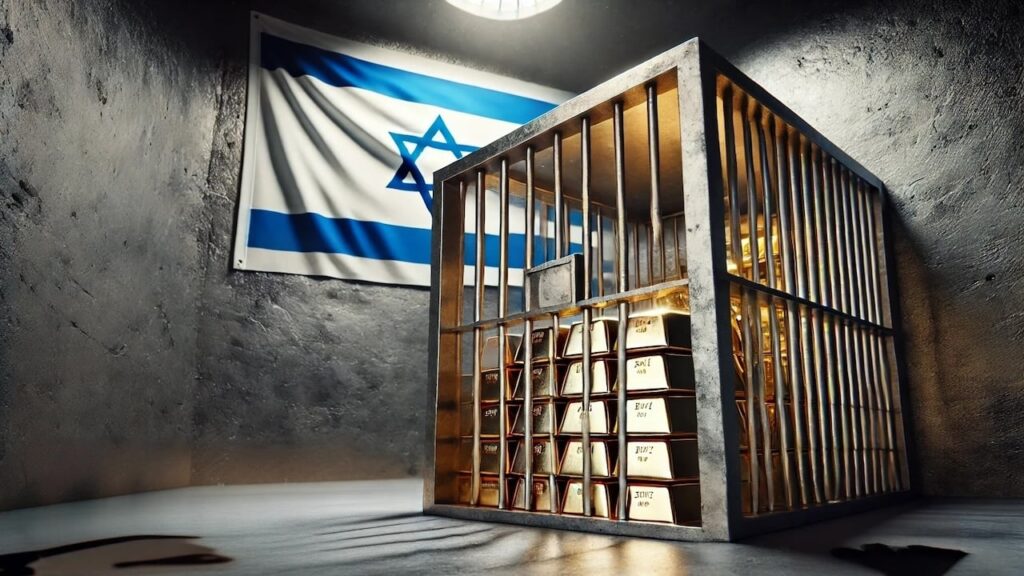
(Mike Maharrey, Money Metals News Service) Israel appears to be poised to take the war on cash to another level by eliminating the highest denomination of Israeli currency and limiting private ownership of gold and silver.
According to a report by YNetNews.com, Prime Minister Benjamin Netanyahu has asked high-ranking government officials to discuss the elimination of the 200-shekel banknote. Netanyahu called for the sweeping move to “curb illicit cash flows” and fight “black market money.”
This is government-speak for increasing tax receipts. According to the report, the plan could boost state tax revenues by 90 to 115 billion shekels ($24 to $31 billion) by 2030.
According to YNet, this would be the first step in a more comprehensive plan. In the medium term, officials hope for “a drastic reduction” in cash use with the ultimate goal of completely eliminating cash transactions. All transactions in the country would be made via credit/debit cards or bank transfers.
The plan would also ban private individuals and companies from holding “large amounts” of “cash alternatives,” including gold and silver.
In effect, Netanyahu hopes to ban all physical money and push society to electronic transactions.
The plan would reportedly roll out quickly, allowing a very short amount of time to change out 200-shekel notes. According to YNet, “This is expected to hinder criminal organizations from disposing of millions of notes.”
Other aspects of the plan include an expansion of financial reporting requirements, the creation of a multi-agency enforcement program, the implementation of AI to identify and track tax evaders, and increased oversight of non-bank financial entities such as currency exchanges.
This isn’t Israel’s first move against cash. In 2022, the government banned the use of cash in business transactions over 6,000 shekels ($1,625). Private cash transactions can’t exceed 15,000 shekels ($4,063). Any transaction above those thresholds must be made via bank transfer or a debit card.
The War on Cash
This proposed Israeli plan is part of a broader global “war on cash.
Governments around the world would like to minimize or even eliminate the use of cash. To achieve that aim, governments implement various policies, including removing large-denomination notes from circulation, increasing the cost of cash transactions, levying fees on obtaining cash, and, at the extreme, eliminating cash altogether.
The Israeli proposal takes things to a whole new level by limiting possession of real money – gold and silver.
Government officials sell the war on cash to the public as a matter of convenience, arguing that electronic transactions are much easier and hassle-free.
Government people also claim that getting rid of cash will stop criminals who use it to evade tracking and detection.
But there is a more sinister rationale for a war on cash that government officials won’t talk about out loud.
It’s a matter of control.
Imagine if there was no cash or physical money. It would become impossible to hide any transaction from the government’s eyes. Officials would know all about your morning trip to Dunkin’, your shopping spree at the gun store, and your most recent medical procedures.
In a cashless society, the government could track and record virtually every move you make, turning the banking and financial system into a massive surveillance network.
A cashless society would ultimately give the government complete control of your money. And that means significant control over you. Virtually every action you take would be subject to government scrutiny.
As the Israeli government admits, eliminating cash would facilitate the maximum collection of taxes and fees. It would make it easier for central banks to “incentivize” spending with negative interest rates. And in the worst-case scenario, the government could shut off your ability to make transactions.
If you hold cash, or even better, gold and silver, you can make transactions with virtually anybody in private. Nobody needs to know. You can also protect your wealth from the banking system by stuffing cash under your matters or holding gold and silver in your safe. Without cash or real money, your entire financial life is subject to government scrutiny and control.
Israel isn’t the first country to fire shots in the war on cash.
In 2019, the International Monetary Fund (IMF) published a working paper outlining policies to move toward a cashless society even in the face of public opposition.
“Although some countries most likely will de-cash in a few years, going completely cashless should be phased in steps. The de-cashing process could build on the initial and largely uncontested steps, such as the phasing out of large denomination bills, the placement of ceilings on cash transactions, and the reporting of cash moves across the borders. Further steps could include creating economic incentives to reduce the use of cash in transactions, simplifying the opening and use of transferrable deposits, and further computerizing the financial system.”
The paper also suggested private institutions should lead the way to minimize the (very real) impression that governments are trying to control the population.
“In any case, the tempting attempts to impose de-cashing by a decree should be avoided, given the popular personal attachment to cash. A targeted outreach program is needed to alleviate suspicions related to de-cashing; in particular, that by de-cashing, the authorities are trying to control all aspects of peoples’ lives, including their use of money, or push personal savings into banks. The de-cashing process would acquire more traction if it were based on individual consumer choice and cost-benefits considerations.”
This isn’t merely a theoretical policy.
Beginning in 2016, the European Central Bank phased out the 500-euro note.
In 2023, more than a billion dollars in physical cash disappeared from circulation in Australia. 9News called it “the strongest sign yet” that the country is moving toward a cashless society.
Officials in the U.S. have also flirted with the war on cash. Former Treasury Secretary and Obama economic advisor Lawrence Summers floated the idea of eliminating the $100 bill.
These are just a few examples of government actions taken to eliminate cash.
While the idea may seem benign, it is nothing but a massive government power grab.
Mike Maharrey is a journalist and market analyst for MoneyMetals.com with over a decade of experience in precious metals. He holds a BS in accounting from the University of Kentucky and a BA in journalism from the University of South Florida.