
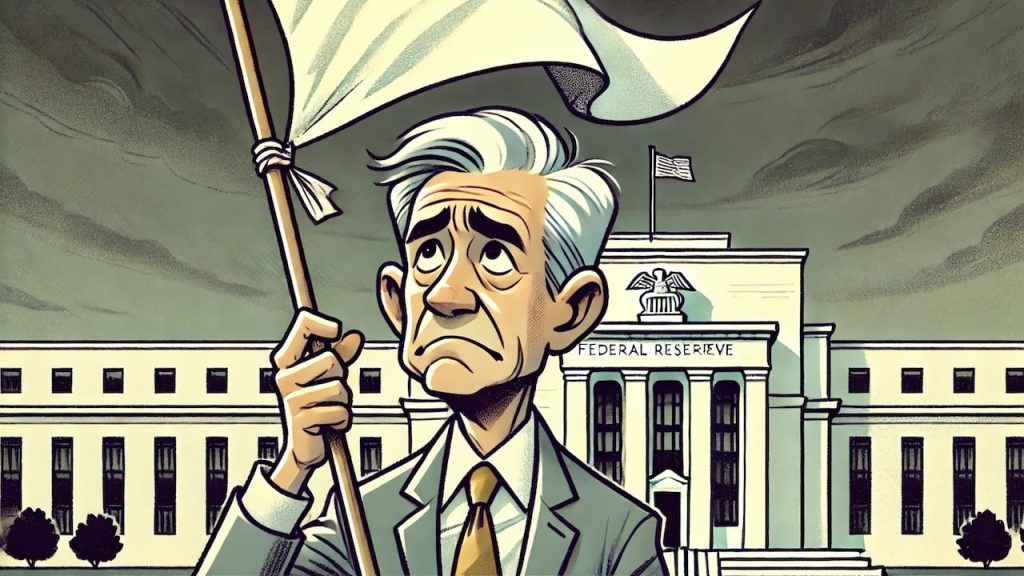
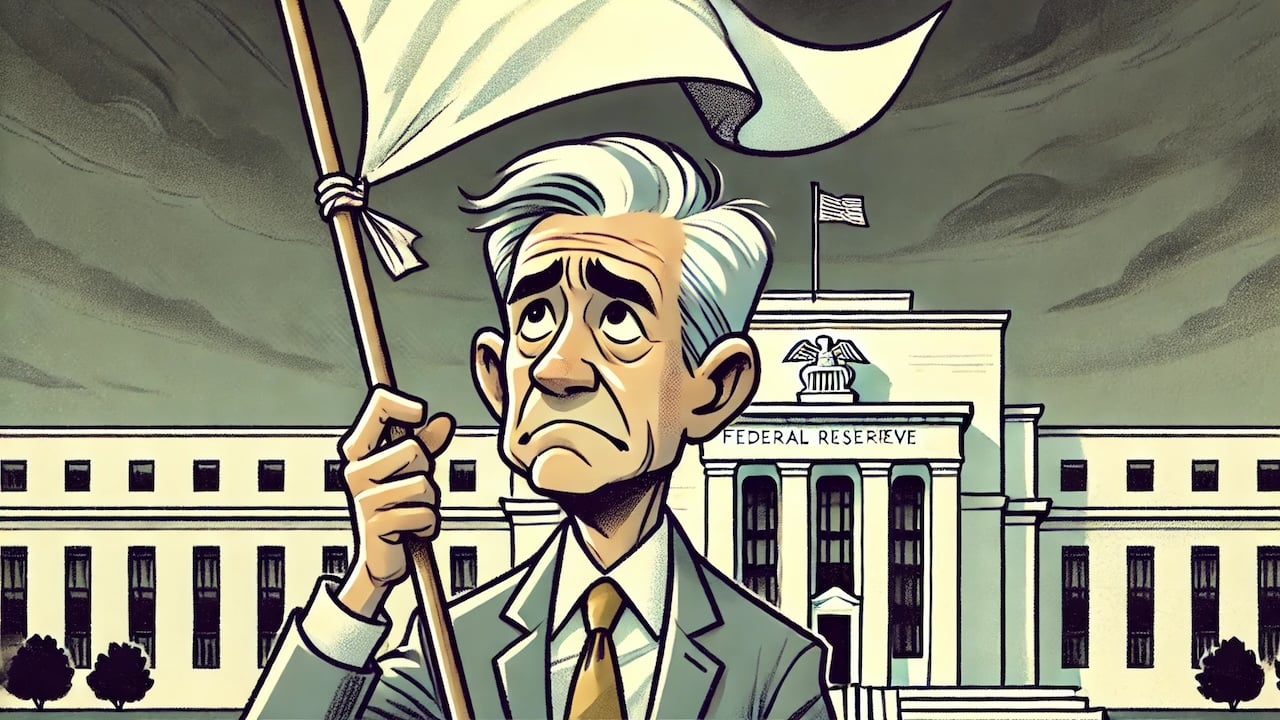
(Mike Maharrey, Money Metals News Service) The Federal Reserve unfurled the white flag during the July FOMC meeting and set the stage to surrender to inflation.
That may seem like an odd way to frame the messaging that came out of the most recent Fed meeting, but surrender is exactly what Powell & Company are set to do. The inflation dragon might be woozy, but he isn’t dead, and the central bank appears to be set to revive him with a hit of easy money in September.
The Fed didn’t make any policy changes at the July meeting, holding rates steady at between 5.25 and 5.5 percent. But the messaging coming out of the meeting took a strong dovish turn and began signaling an impending rate cut.
The first hint was in the official FOMC statement. Instead of describing inflation as “elevated,” it called it “somewhat elevated,” and instead of saying “the committee remains highly attentive to inflation risks,” the statement declared “the committee is attentive to both sides of its dual mandate.”
Jerome Powell’s Open-Mouth Operations
Federal Reserve Chairman Jerome Powell likes to use his podium to front-run monetary policy. He knows markets will parse his words and respond accordingly. During his post-meeting press conference, Powell gave the strongest hints yet that the Fed is officially tapping out of the inflation fight, most likely next month.
“If we were to see inflation moving down … more or less in line with expectations, growth remains reasonably strong, and the labor market remains consistent with current conditions, then I think a rate cut could be on the table at the September meeting.”
Powell stopped short of calling a September cut a certainty, leaving himself a little wiggle room.
“We’re getting closer to the point at which it’ll be appropriate to reduce our policy rate, but we’re not quite at that point.”
Powell left the door open for anywhere between “zero cuts and several cuts” before the end of the year.
Nevertheless, the mainstream almost universally believes a cut is coming at the next meeting and the markets are pricing for that eventuality.
Moody Analytics chief economist Mark Zandi told the AP, “They’re ready to cut.”
“Just as long as we don’t get an inflation surprise between now and September, which we won’t.”
SiebertNXT CIO Mark Malek offered Reuters a similar take.
“Listening to him speak, it’s clear they’re all locked and loaded for a September rate cut and they’re going to maintain their optionality.”
The Fed Is Already Withdrawing from the Inflation Fight
Even before yesterday’s verbal pivot, the Fed was already winding down the inflation fight.
As I reported earlier this week, the central bank already loosened monetary policy when it quietly announced that it would begin to taper balance sheet reduction in June.
The balance sheet serves as a direct pipeline to the money supply. When the Fed buys assets – primarily U.S. Treasuries and mortgage-backed securities – it does so with money created out of thin air. Those assets go on the balance sheet and the new money gets injected into the economy.
This expansion of the money supply is, by definition, inflation.
If expanding the money supply is inflationary, it logically follows that to slay price inflation, the Fed needs to significantly shrink the balance sheet. Rate hikes aren’t enough to ring all the liquidity out of the economy. In other words, if the Fed was serious about taming inflation, it would be talking about additional rate hikes and ramping up efforts to reduce the size of the balance sheet. It needs to undo the money creation of the past decade-plus.
I didn’t and it won’t.
The Fed is already winding down balance sheet reduction having only reduced it by $1.76 trillion, a fraction of the nearly $5 trillion it added during the pandemic alone. This indicates that it is withdrawing from the battlefield while inflation is alive and well.
Inflation Isn’t Dead
Why do I call this a surrender?
Because inflation isn’t dead.
And if the Fed was serious about slaying inflation, it wouldn’t be on the cusp of creating more inflation.
Keep in mind, inflation is an expansion of money and credit. Price inflation is one symptom of inflationary policy.
The Fed has tightened things up just enough to slow rising prices, but as we can see from the balance sheet, most of the inflation created during the pandemic is still sloshing around in the economy. And that’s on top of all the inflation it created in the wake of the 2008 financial crisis that the central bank never managed to wring out of the economy.
But by slowing balance sheet reduction and signaling interest rate cuts, the Fed is telling you it plans to ramp up the inflation machine.
Meanwhile, price inflation remains well above the mythical 2 percent target. Even the Fed’s “preferred” inflation measure undercuts the “inflation is dead” narrative. The PCE heated up slightly month-on-month in June. (This measure is preferred because it understates rising prices the most.) The core PCE price index gained 0.2 percent and is still up 2.6 percent year-on-year. But the mainstream mostly focused on the headline number that dropped from 2.6 percent to 2.5 percent.
So, why loosen monetary policy?
Powell & Company know that this debt-riddled, bubble economy can’t continue to function in an even moderately tighter interest rate environment. That’s why everybody is desperate for rate cuts.
In other words, everybody knows this economy runs on inflation and they need it back.
What Does This Mean for Gold and Silver?
So, what is a gold and silver investor to do with this info?
The mainstream consensus has been to sell gold and silver anytime Powell & Company comes out hawkish, or good economic data indicates the economy is still rolling along. (This is because there is a misguided notion that a strong economy creates inflation. It doesn’t. Money creation causes price inflation.) The mainstream buys gold and silver when the Fed gets doveish or CPI data indicates price inflation might be cooling. This raises hope that interest rate cuts are in the pipeline.
This FOMC meeting was no exception. Gold rallied to move back above $2,450 after it ended.
I’m just going to throw this out there. Instead of making knee-jerk moves based on the last thing on X (formerly known as Twitter), folks might be wise to look at the underlying dynamics.
The reality is the Fed is stuck between a rock and a hard place. The central bank has not done enough to slay price inflation. But the Fed has made monetary policy “sufficiently tight” to break things in this debt-riddled, bubble economy. It has already sparked a financial crisis that continues to bubble under the surface. The world is still buried in debt. Governments continue to borrow and spend. There are still all kinds of malinvestments in the economy.
It’s only a matter of time before the economy unravels. That’s when the markets will get the rate cuts they desperately want – even though inflation still has a heartbeat.
Of course, that means more price inflation.
And this is exactly what Powell & Company are telling you. They’re waving the white flag. They’re letting the inflation dragon off the mat.
Given this fact, you might want to consider an inflation hedge.
Mike Maharrey is a journalist and market analyst for MoneyMetals.com with over a decade of experience in precious metals. He holds a BS in accounting from the University of Kentucky and a BA in journalism from the University of South Florida.