
(Headline USA) Big Pharma is breeding Genetically modified pigs to provide organs for human transplants.
The first gene-edited pig organs ever transplanted into people came from animals born on a special research farm in the Blue Ridge mountains – behind locked gates, where entry requires washing down your vehicle, swapping your clothes for medical scrubs and stepping into tubs of disinfectant to clean your boots between each air-conditioned barn.
“These are precious animals,” said David Ayares of Revivicor Inc., who spent decades learning to clone pigs with just the right genetic changes to allow those first audacious experiments.
The biosecurity gets even tighter just a few miles away in Christiansburg, Virginia, where a new herd is being raised – pigs expected to supply organs for formal studies of animal-to-human transplantation as soon as next year.
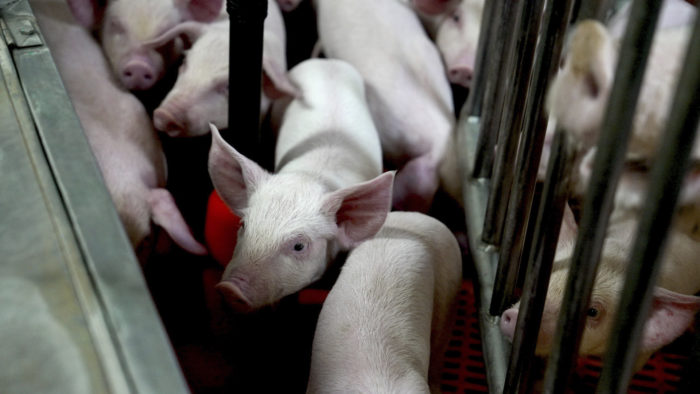
This massive first-of-its-kind building bears no resemblance to a farm. It’s more like a pharmaceutical plant. And part of it is closed to all but certain carefully chosen employees who take a timed shower, don company-provided clothes and shoes, and then enter an enclave where piglets are growing up.
“We designed this facility to protect the pigs against contamination from the environment and from people,” said Matthew VonEsch of United Therapeutics, Revivicor’s parent company.
The Associated Press got a peek at what it takes to clone and raise designer pigs for their organs – including a $75 million “designated pathogen-free facility” built to meet Food and Drug Administration safety standards for xenotransplantation.
After decades of failed attempts, companies including Revivicor, eGenesis and Makana Therapeutics are engineering pigs to be more humanlike.
So far in the U.S. there have been four “compassionate use” transplants, last-ditch experiments into dying patients — two hearts and two kidneys. Revivicor provided both hearts and one of the kidneys.
The four patients died within a few months.
Now the FDA is evaluating promising results from experiments in donated human bodies and awaiting results of additional studies of pig organs in baboons before deciding next steps.
The main challenges include how to avoid rejection and whether the animals might carry some unknown infection risk.
The process starts with modifying genes in pig skin cells in a lab. Revivicor initially deleted a gene that produces a sugar named alpha-gal, which triggers immediate destruction from the human immune system. Next came three-gene “knockouts,” to remove other immune-triggering red flags. Now the company is focusing on 10 gene edits — deleted pig genes and added human ones that together lessen risk of rejection and blood clots plus limit organ size.
They clone pigs with those alterations, similar to how Dolly the sheep was created.
Twice a week, slaughterhouses ship Revivicor hundreds of eggs retrieved from sow ovaries. Working in the dark with the light-sensitive eggs, scientists peer through a microscope while suctioning out the maternal DNA. Then they slip in the genetic modifications.
“Tuck it in nice and smooth,” murmurs senior researcher Lori Sorrells, pushing to just the right spot without rupturing the egg. Mild electric shocks fuse in the new DNA and activate embryo growth.
Ayares, a molecular geneticist who heads Revivicor and helped create the world’s first cloned pigs in 2000, says the technique is “like playing two video games at the same time,” holding the egg in place with one hand and manipulating it with the other. The company’s first modified pig, the GalSafe single gene knockout, now is bred instead of cloned. If xenotransplantation eventually works, other pigs with the desired gene combinations would be, too.
Hours later, embryos are carried to the research farm in a handheld incubator and implanted into waiting sows.
Tags on their ears identify their genetics.
But in neighboring Christiansburg is the clearest signal that xenotransplantation is entering a new phase — the sheer size of United Therapeutics’ new pathogen-free facility. Inside the 77,000-square-foot building, the company expects to produce about 125 pig organs a year, likely enough to supply clinical trials.
It will take years of clinical trials to prove whether xenotransplantation really could work. But if it succeeds, United Therapeutics’ plan is for even larger facilities, capable of producing up to 2,000 organs a year, in several places around the country.
Adapted from reporting by the Associated Press